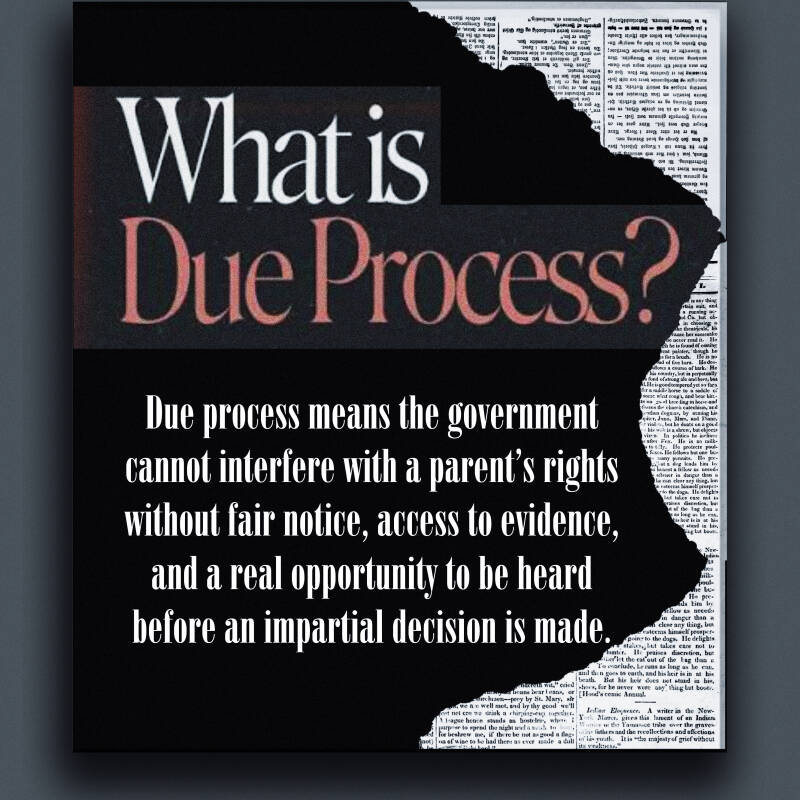
Due Process in Name Only
How Parents Lose Rights Without Ever Being Properly Heard
One of the most dangerous myths in child welfare is that parents are given “due process.” On paper, that sounds reassuring. In real life, it often means nothing more than forms, deadlines, and hearings that happen whether you understand them or not. Due process is supposed to mean notice, a real opportunity to be heard, and decisions based on evidence. But for many parents involved with CPS, what actually happens is very different.
You Are Technically Notified — But Practically Excluded
Parents are often “served” paperwork filled with legal language they are not trained to understand. Deadlines are short. Instructions are vague. Consequences are severe.
Hearings move forward even when:
- Parents do not understand what is being alleged
- Records are incomplete or unavailable
- Evidence has not been disclosed
- Allegations are based on summaries, not facts
Being present is not the same as being heard. And confusion is later reframed as noncompliance.
Decisions Are Made Before Parents Speak
In many cases, key decisions are already formed before a parent ever testifies. Case narratives are written early. Risk levels are assigned quickly. Recommendations are made quietly. By the time a parent is allowed to respond, the framing is already in place. The hearing becomes a formality — not a fact-finding process. The Burden Is Always on the Parent In theory, CPS should have to prove risk. In practice, parents must prove innocence.
Parents are expected to:
- Disprove allegations they didn’t make
- Correct records they didn’t write
- Explain decisions they weren’t consulted on
- Defend themselves against assumptions
Meanwhile, agencies are rarely required to explain inconsistencies, missing documentation, or shifting justifications. Silence Is Interpreted as Guilt — Speaking Is Treated as Conflict If you stay quiet, you are seen as disengaged. If you speak up, you are labeled difficult.
Parents are placed in an impossible position:
- Advocacy becomes defiance
- Emotion becomes instability
- Questions become resistance
Due process collapses when a parent’s voice is treated as a problem instead of evidence.
Temporary Orders Become Permanent Damage One of the least understood realities of family court is this:
Temporary orders often shape the entire outcome. Early restrictions on visitation, contact, or decision-making are later cited as “status quo.” Delays become justification. Limited access becomes “bonding concerns.” What was supposed to be temporary becomes irreversible. Not because of new findings — but because time passed.
When Records Matter More Than Reality Parents may never see:
- Full investigative notes
- Internal communications
- Placement concerns
- Prior ruled-out allegations
But those records still influence decisions. Once something is written into the file, it carries forward — even if it was wrong, exaggerated, or never proven. Due process fails when parents cannot meaningfully challenge the very information shaping their case.
This Is How Rights Are Lost Quietly
There is rarely one dramatic moment where parental rights disappear. Instead, it happens through accumulation:
- Missed opportunities to respond
- Unchallenged assumptions
- Delays framed as deficiencies
- Silence mistaken for agreement
By the time termination is discussed, the groundwork has already been laid. And parents are told the outcome was inevitable.
Why This Matters
Children lose parents not because courts carefully weighed evidence — but because systems moved faster than truth. Parents lose rights not because they were proven unfit — but because they were never fully heard. Due process should protect families, not process them out of existence.
Why This Blog Continues
This space exists because records matter. Because timelines matter. Because children deserve decisions based on truth — not momentum. And because parents deserve more than the illusion of fairness. This is not about avoiding accountability. It is about demanding real process — before families are permanently changed.
Author: Alexis Landrum
Add comment
Comments