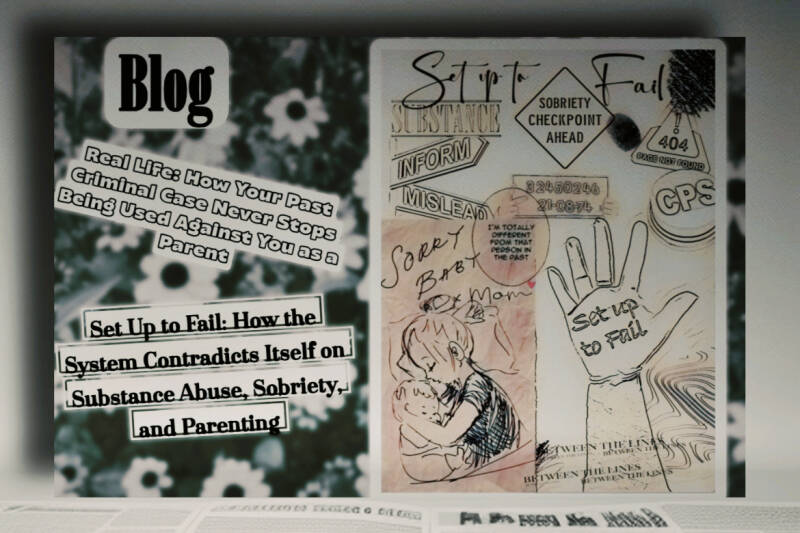
“set up” to fail
Part 2 of 2:
Set Up to Fail How the System Contradicts Itself on Substance Abuse, Sobriety, and Parenting
Parents involved in CPS cases are often told the system is designed to help them succeed. In reality, many of us learn the hard way that the system teaches one thing and punishes another—especially when substance use is involved.
This is not opinion.
This is lived experience.
The First Contradiction: Treatment vs. Termination
When substance use is part of a CPS case, parents are required to complete substance abuse classes or treatment programs.
Those programs consistently teach the same core principles:
- Addiction is a lifelong condition
- Recovery is ongoing
- Relapse is a known risk
- Safety planning matters more than punishment
- Having a relapse plan protects the parent, the child, and the family
Parents are taught to be honest.
- To ask for help.
- To plan for setbacks.
- To use support systems like AA or NA.
- To recognize relapse as part of recovery—not moral failure.
We are told this honesty is what keeps families safe.
The Legal Reality That Comes After
Then family court applies a completely different rule. Under family law, a relapse after completing treatment can be used as grounds to:
- Extend cases indefinitely
- Deny reunification
- Support termination of parental rights
In plain language:
You are required to take a class that tells you relapse is real—and then punished when it happens.The same system that mandates treatment uses the very framework of addiction against parents when it becomes legally convenient.
Relapse Plans That Become Evidence Against You
Parents are often required to create relapse prevention plans as part of their CPS service plans.
These plans include:
- Who to call
- Where the child will stay
- How to keep everyone safe
The intent is harm reduction.
But in practice, these plans are later reframed as proof that:
- The parent is “likely to relapse”
- Sobriety is “unstable”
- Risk is “ongoing”
Preparation is treated as prediction. Honesty is treated as admission.
“We Don’t Use Your History Against You”—Except We Do Parents are repeatedly told that past cases don’t count if they were closed, ruled out, or unsubstantiated.
That is not how it works in real life.
- Every CPS call matters.
- Every investigation matters.
- Every family-based case matters.
Even when allegations were ruled out, they are still:
- Read
- Remembered
- Referenced
- Used to shape narratives in new cases
Unfounded allegations don’t disappear—they quietly become “patterns.” So when a new report comes in, caseworkers aren’t starting fresh. They are building on a file that already exists—often filled with allegations that were never proven.
The Impossible Standards of “Stability"
Parents are often required to show “stability,” but what that means is inconsistent and sometimes irrational.
We are told to:
- Obtain housing
- Maintain employment
- Have reliable transportation
Yet there is no law that says a parent must:
- Own a car
- Have a driver’s license
Many parents create legitimate transportation plans:
- Uber and rideshare
- Public transportation
- Friends and family
- Delivery services
Still, those plans are rejected.
Instead, parents are accused of hypothetical future behavior:
“You’ll end up driving without a license.”
Not because it happened. But because the system assumes it might. Speculation replaces evidence. The Bigger Truth No One Says Out Loud The system is not designed around recovery—it is designed around risk avoidance.
And risk is often defined by:
- Past mistakes
- Prior cases
- Old allegations
- Assumptions about relapse
No matter how much a parent complies, the finish line keeps moving.
What This Means for Parents This creates a devastating reality:
- You are required to be honest—but punished for honesty.
- You are required to prepare—but punished for preparation.
- You are required to change—but never allowed to be changed.
- Sobriety is demanded—but perfection is expected.
And perfection is not how recovery works.
Why This Matters
Parents are not losing their children because they failed services. They are losing them because the system refuses to reconcile its own contradictions. Children lose parents who were doing the work. Families are broken not by relapse—but by policy.
What Needs to Change
- Relapse must be treated as a safety issue, not an automatic termination trigger
- Unsubstantiated allegations must not be reused as evidence
- Parents must be judged on present facts, not cumulative suspicion
- Recovery must be recognized as nonlinear—because that is medical reality
Until then, the system will continue to say it wants rehabilitation—while quietly ensuring failure.
And parents will keep paying the price.
Author: Alexis Landrum
Add comment
Comments